Who Is Harumafuji?
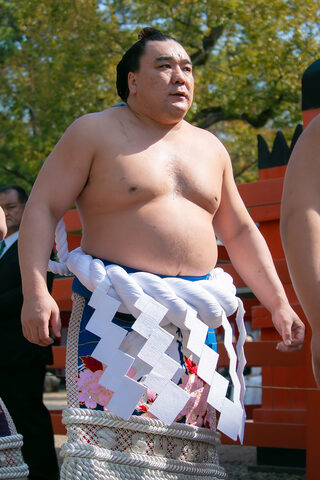
Photo: Ogiyoshisan / CC BY-SA 4.0
Harumafuji Kohei (日馬富士 公平), born Davaanyam Byambadorj on April 14, 1984 in Ulaanbaatar, Mongolia, was the 70th Yokozuna in the history of professional sumo — one of three Mongolian Yokozuna active simultaneously alongside Hakuho and Kakuryu. He competed from Isegahama stable and retired in November 2017 with 9 tournament championships to his name.
What made Harumafuji exceptional was not raw power — at 185cm and around 137kg he was notably lighter than most Yokozuna — but the electric speed and technical precision that earned him comparisons to a lightning strike. In a sport that often rewards size and brute force, Harumafuji proved that intelligence, agility, and timing could carry a wrestler to sumo's highest rank.
His career is inseparable from its ending: a late-night incident in October 2017, involving fellow Mongolian wrestler Takanoiwa, triggered one of the most turbulent scandals in modern sumo. Harumafuji resigned within weeks, and the full context of that night remains contested. Understanding his story requires looking at both the brilliance of his career and the complexity of its conclusion.
Personal Background
Early Life in Mongolia
Davaanyam Byambadorj grew up in Ulaanbaatar during a period of rapid social change in post-Soviet Mongolia. Like many young Mongolians of his generation who would go on to dominate sumo, he was shaped by a culture with deep wrestling traditions — Mongolian wrestling (bökh) has been practiced for centuries and remains central to national identity.
He was recruited to Japan in his teens and joined Ajigawa stable, beginning his professional career in January 2001 under the shikona (ring name) Davaanyam. He took the ring name Harumafuji in 2004, a name that combined the Japanese characters for "spring" (春) and "Mt. Fuji" (富士) — an evocative combination befitting a wrestler of ambition.
Stable Life
When Ajigawa stable dissolved in 2008, Harumafuji transferred to the prestigious Isegahama stable, where he would spend the rest of his career. Isegahama stable, led by former Yokozuna Terao, had a reputation for producing technically refined wrestlers — an environment that suited Harumafuji's style perfectly.
Career Timeline
| Date | Milestone |
|---|---|
| January 2001 | Professional debut |
| May 2004 | Adopts ring name Harumafuji |
| January 2006 | Reaches top Makuuchi division |
| January 2008 | Promoted to Ozeki |
| 2008 | Transfers to Isegahama stable (Ajigawa dissolution) |
| May 2009 | First yusho (tournament championship) — 14-1 as Ozeki |
| July 2011 | Second yusho |
| July 2012 | Third yusho — perfect 15-0 |
| September 2012 | Fourth yusho (15-0) — earns Yokozuna promotion |
| September 2012 | Promoted to 70th Yokozuna (ranked as Yokozuna from the November 2012 basho) |
| 2013–2017 | Active Yokozuna — 5 further yusho |
| October 2017 | Incident involving Takanoiwa at a social gathering |
| November 29, 2017 | Announces retirement |
Career Statistics
Yusho Breakdown
| # | Tournament | Year | Record |
|---|---|---|---|
| 1 | Natsu (May) | 2009 | 14-1 |
| 2 | Nagoya (July) | 2011 | 14-1 |
| 3 | Nagoya (July) | 2012 | 15-0 |
| 4 | Aki (September) | 2012 | 15-0 |
| 5 | Hatsu (January) | 2013 | 15-0 |
| 6 | Kyushu (November) | 2013 | 14-1 |
| 7 | Kyushu (November) | 2015 | 13-2 |
| 8 | Nagoya (July) | 2016 | 13-2 |
| 9 | Aki (September) | 2017 | 11-4 |
Fighting Style & Techniques
Harumafuji's fighting style is best described as explosive and cerebral. Where many Yokozuna win through overwhelming mass and forward pressure, Harumafuji won through timing, deception, and speed that opponents simply could not match.
Speed as a Weapon
His tachiai (initial charge) was among the fastest ever measured — he could be at his opponent's chest and controlling the position before most wrestlers had processed the start of the bout. This speed compressed the decision-making time available to opponents, often leaving them reacting rather than acting.
Versatility
Harumafuji was comfortable in both pushing bouts (oshi) and belt-fighting bouts (yotsu). This versatility was unusual and made him extremely difficult to prepare against. He won with a wide range of kimarite (winning techniques) — from straightforward yorikiri (force-outs) to spectacular throws like uwatenage and shitatenage.
Ring Intelligence
Perhaps his most underrated quality was his ring intelligence. He read opponents exceptionally well, setting traps and reversing momentum in ways that seemed effortless. His bouts were rarely grinding affairs — he preferred quick, decisive action that minimized the advantage heavier opponents might gain in a prolonged struggle.
Life as Yokozuna
Harumafuji's promotion to Yokozuna in September 2012 made him one of three active Mongolian Yokozuna — a historically unprecedented situation. He joined Hakuho (69th) and Kakuryu (71st) at the top of the sport, creating a Mongolian dominance that defined an era in sumo.
As Yokozuna, Harumafuji bore the additional ceremonial and cultural responsibilities that the rank entails. The tsuna (ceremonial rope) worn during ring-entering ceremonies weighs around 15kg and represents a connection to Shinto ritual stretching back centuries. Beyond the dohyo, Yokozuna are expected to embody hinkaku — a dignified bearing that reflects well on the sport.
His five years as Yokozuna were productive but not without difficulty. Injuries — a recurring challenge for wrestlers operating at elite level — required careful management. Despite this, he continued competing at a high level through 2017, winning his final yusho in September 2017.
📺 Watch Harumafuji's Greatest Bouts
The Japan Sumo Association posts official highlight clips on YouTube. To watch full archived tournaments from outside Japan, a VPN lets you access ABEMA's full match library.
🔒 Get NordVPN — Watch Sumo AbroadThe Retirement Controversy
On October 25, 2017, during a social gathering in Tottori following a charity exhibition, an altercation occurred between Harumafuji and fellow wrestler Takanoiwa (also Mongolian, from Tagonoura stable). The incident reportedly began over Takanoiwa's phone use during what older wrestlers considered a formal group setting.
Takanoiwa subsequently withdrew from the Kyushu tournament citing injuries, and his stable master reported the incident to the Japan Sumo Association. News broke in mid-November, triggering intense media scrutiny and public debate.
The Investigation
The JSA launched an investigation. Harumafuji acknowledged striking Takanoiwa with a beer bottle during the incident. The degree of force applied, the context, and the full sequence of events were disputed — but the outcome was not. On November 29, 2017, Harumafuji held a press conference and announced his retirement, taking personal responsibility for the incident.
Reactions and Context
The incident sparked complex discussions within and outside the sumo community. Some emphasized the seriousness of the physical harm; others pointed to the broader dynamics of sumo's hierarchical culture, drinking traditions at social events, and the particular pressures on Mongolian wrestlers navigating Japanese institutional expectations. The full truth of that night has never been definitively established in public.
What is clear is that the incident ended a distinguished career prematurely. Harumafuji was 33 at the time of his retirement — an age at which many wrestlers continue to compete.
Legacy & Impact
Despite the circumstances of his retirement, Harumafuji's legacy in sumo is secure. His 9 yusho titles place him among the more successful Yokozuna of the modern era — fewer than Hakuho's record 45, but more than most who have held the title.
His technical style left a lasting impression on how fans and analysts think about the relationship between size and success in sumo. He demonstrated that speed and intelligence could compensate for a relative deficit in mass — a lesson that influenced how subsequent wrestlers (and their coaches) approached the sport.
In Mongolia, he remains a celebrated figure. The country has an outsized relationship with sumo's highest ranks, and Harumafuji is part of a generation of Mongolian wrestlers who transformed global perceptions of the sport.
How Harumafuji Compares
| Yokozuna | Number | Yusho | Notable for |
|---|---|---|---|
| Hakuho | 69th | 45 | All-time record holder |
| Harumafuji | 70th | 9 | Speed, technique, versatility |
| Kakuryu | 71st | 6 | Consistency, calm ring presence |
| Kisenosato | 72nd | 2 | First Japanese Yokozuna since 1998 |
| Terunofuji | 73rd | 8 | Greatest comeback in sumo history |
| Hoshoryu | 74th | 3+ | Acrobatic throws, ring craft |