Watch Sumo Live & On Demand
Follow active Yokozuna and catch all six Grand Sumo Tournaments throughout the year on NHK World. Revisit legendary bouts from Asashoryu's era in the official archives.
Watch on NHK World →🏆 Who Is Asashoryu?
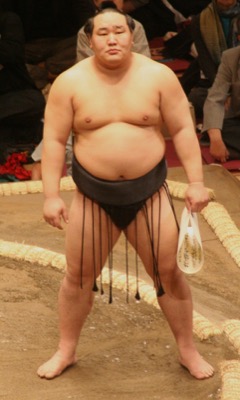
Photo: Arcimboldo / Eckhard Pecher / CC BY 3.0
Asashoryu (朝青龍 明徳, ring name Asashoryu Akinori; born Dolgorsürengiin Dagvadorj) is the 68th Yokozuna in professional sumo and universally regarded as the most dominant sumo wrestler of the 2000s decade. Born on September 27, 1980, in Ulaanbaatar, Mongolia, he came to Japan in 1997 to study at Meitoku Gijuku High School (明徳義塾高校, Kochi Prefecture) on a sumo scholarship, later dropping out to join Wakamatsu Stable (若松部屋) — a decision that would transform the sport and inspire a generation of Mongolian wrestlers.
Over an 11-year professional career from 1999 to 2010, Asashoryu accumulated 25 tournament championships (yusho) and achieved records that remain unmatched to this day. Chief among them: in 2005, he won all six official Grand Sumo Tournaments in a single calendar year — a feat no wrestler before or since has ever accomplished. He also held the title of sole active Yokozuna for approximately three years following the retirements of Akebono (2001), Takanohana (2003), and Musashimaru (2003), carrying the weight of the sport's highest rank entirely on his own shoulders.
Asashoryu's career was defined by paradox. On the dohyo (sumo ring), he was electrifying — explosive, technically superb, psychologically fearsome, and intensely competitive. Off the dohyo, his career was punctuated by controversies that kept him in the news even when he was winning at historic rates. His February 2010 retirement — forced amid ongoing tensions with the Japan Sumo Association — was deeply controversial, with many in the sumo world feeling a great champion had been driven out prematurely.
Today, Asashoryu's legacy is debated but undeniable. He brought a new level of intensity and athleticism to the sport, blazed the trail for the wave of Mongolian wrestlers who would come to dominate sumo through the 2000s and 2010s, and produced some of the most thrilling performances the sport has ever seen.
🇲🇳 Early Life — From Mongolia to Japan
Childhood in Ulaanbaatar
Dolgorsürengiin Dagvadorj was born on September 27, 1980, in Ulaanbaatar, the capital of Mongolia. He grew up in a country with deep traditions of wrestling — Mongolian wrestling (Bökh) has been practiced for centuries and remains one of the country's most celebrated sports. From an early age, Dagvadorj showed natural athletic ability and a fierce competitive drive that would define his entire life.
Mongolia at the time was navigating its transition away from the Soviet era, and opportunities for elite athletes to compete at the highest international levels were limited. Sumo — which had already seen a handful of Mongolian practitioners begin to make their mark in Japan — represented an extraordinary opportunity for a young, ambitious wrestler.
Moving to Japan at Age 15
In 1997, at approximately 16 years old, Dagvadorj traveled from Ulaanbaatar to Japan to attend Meitoku Gijuku High School (明徳義塾高校) in Kochi Prefecture — a school well known for its sumo program. He left the school before graduating and joined Wakamatsu Stable (若松部屋) in preparation for his professional debut. The decision was life-changing — he arrived in a country with a different language, culture, and set of expectations, far from his family.
Wakamatsu Stable (若松部屋) trained him under the guidance of stable master Asashio Oyakata (former Ozeki Asashio IV, 4th generation 朝潮). The stable was later merged into Takasago Stable (高砂部屋). Under this training environment, the young Mongolian recruit quickly stood out — his natural athleticism, physical coordination, and extraordinary competitive instinct were evident from early on.
Life at a sumo stable for a junior wrestler is famously demanding — long training hours, strict hierarchies, communal living, and intense physical conditioning. For a teenager far from home, this environment could have been overwhelming. Instead, Asashoryu — as he would come to be known — thrived in it, channeling whatever homesickness or cultural displacement he felt into relentless competitive drive on the practice dohyo.
The Path Through the Lower Divisions
Asashoryu made his professional debut in March 1999, entering at the lowest level of the professional sumo pyramid. His ascent through the divisions was rapid by any standard. He displayed a technical versatility and tactical intelligence that set him apart from other prospects, combining the physical wrestling instincts he had developed in Mongolia with the traditional sumo techniques taught at Wakamatsu Stable (若松部屋).
By January 2001, approximately two years after his professional debut, Asashoryu made his Makuuchi (top division) debut — an achievement that typically takes most wrestlers several years to reach. He had arrived at the highest level of professional sumo, and he was still only 20 years old.
📈 Professional Career Rise — Debut to Yokozuna
Makuuchi Debut and Early Top-Division Years
Asashoryu's debut in the Makuuchi division in January 2001 marked the beginning of one of sumo's most extraordinary ascents. The top division of professional sumo is brutal — a world of established veterans, multiple Ozeki (the rank below Yokozuna), and the occasional Yokozuna. Most new entrants struggle to find their footing for years. Asashoryu did not struggle in the conventional sense.
His style was immediately distinctive: faster, more explosive, and more aggressively forward-moving than most wrestlers of his size. He combined outstanding technical skill in belt wrestling (yotsu-zumo) with powerful pushing and thrusting attacks (oshi-zumo), and he seemed to read the intentions of opponents a half-second faster than they could execute them. Wins came quickly.
Rising Through the Ranks
By 2002, Asashoryu had risen to the rank of Ozeki — the second-highest rank in sumo, just below Yokozuna. His performances were consistently outstanding, and he was clearly on a trajectory toward the top. The question in sumo circles was not whether he would become Yokozuna, but when.
The answer came sooner than even optimistic observers had predicted. In November 2002, already holding the rank of Ozeki (the second highest in sumo), Asashoryu won the tournament with a dominant record of 14 wins and 1 loss. He then followed this immediately with another Ozeki-rank victory in January 2003 (also 14–1), making back-to-back championships that clinched his Yokozuna promotion.
Yokozuna Promotion — January 2003
Following his January 2003 yusho and his overall dominant performances, Asashoryu's Yokozuna promotion was announced. He became the 68th Yokozuna in the history of professional sumo — and the first Mongolian-born wrestler to reach the sport's ultimate rank. He was 22 years old.
The promotion carried enormous weight — not just for Asashoryu personally, but for Mongolia, for Wakamatsu/Takasago Stable, and for the entire trajectory of sumo's international development. A Mongolian Yokozuna was unprecedented, and it opened the door to a wave of Mongolian talent that would reshape the sport over the following two decades.
In March 2003, Asashoryu competed in his first tournament as Yokozuna, posting a record of 10–5 — a difficult debut that showed the pressure of the role. The tournament was won by Chiyotaikai. Asashoryu would win his first championship as Yokozuna in May 2003 (13–2), confirming that his promotion was fully deserved.
⭐ The 2005 Calendar Grand Slam — Winning All 6 Tournaments
Of all Asashoryu's achievements, none stands more alone in the history of sumo than his performance in 2005. Professional sumo holds six Grand Tournaments (本場所, honbasho) per year — in January (Hatsu Basho, Tokyo), March (Haru Basho, Osaka), May (Natsu Basho, Tokyo), July (Nagoya Basho), September (Aki Basho, Tokyo), and November (Kyushu Basho, Fukuoka). Each tournament runs 15 days, with each wrestler competing once per day.
In 2005, Asashoryu won every single one of them. All six. A perfect calendar year in sumo that had never been achieved before — and has never been matched since, including by Hakuho who won 45 total championships.
The Six Victories of 2005
January (Hatsu Basho, Tokyo): Asashoryu opened the year with a dominant 15–0 perfect record — a zensho yusho. He did not drop a single bout across all 15 days of competition. The year was already off to an extraordinary start.
March (Haru Basho, Osaka): Coming off the perfect January, some wondered if the pressure and expectations would affect Asashoryu. Instead, he won again — 14–1. One loss across 15 bouts is still exceptional performance. Two consecutive tournament victories had become routine for him, but the pace of dominance was escalating.
May (Natsu Basho, Tokyo): Three in a row. Asashoryu continued his unprecedented run, adding another championship to the year's tally. By now, the question of whether he could sweep all six was being openly asked in Japanese sumo media.
July (Nagoya Basho): Four. The summer heat of Nagoya — notoriously punishing for competitors — posed no obstacle. Asashoryu won his fourth consecutive tournament of 2005, extending his run to six total in the ongoing streak that had begun in 2004.
September (Aki Basho, Tokyo): Five. With one tournament remaining in the year, Asashoryu stood on the threshold of something unprecedented. The sumo world watched with a mixture of awe and disbelief.
November (Kyushu Basho, Fukuoka): Six. Asashoryu won the final tournament of 2005 with a record of 14–1, completing an achievement that had never been accomplished before in the history of professional sumo: winning every single tournament in a calendar year. The calendar grand slam was complete.
Historical Context and Significance
To understand just how unprecedented this achievement is, consider the following: in the decades since, no wrestler has come close to matching it. Hakuho, who went on to win 45 championships — nearly double Asashoryu's total — never managed to sweep all six in a single year. The closest anyone has come in recent times is winning four or five tournaments in a year.
The 2005 calendar grand slam cemented Asashoryu's place in sumo history as more than simply a great Yokozuna — it made him the owner of a record that may never be broken. In a sport where the competition is relentless and any given tournament's 15 bouts can turn on a single misstep, perfection over an entire year is a standard that defies probability.
👑 The Sole Yokozuna Era (2003–2006)
In the world of professional sumo, the Yokozuna rank carries a unique and heavy burden. Unlike all other ranks, a Yokozuna is never demoted for poor performance — the expectation is that if you can no longer compete at a Yokozuna's level, you retire. This means that every tournament, every loss, carries a weight of honor and obligation that wrestlers at lower ranks do not face.
Now imagine bearing that burden entirely alone — as the only active Yokozuna in the sport — for approximately three years.
How Asashoryu Became Sole Yokozuna
When Asashoryu was promoted to Yokozuna in January 2003, Musashimaru (67th Yokozuna) was still active. Following Musashimaru's retirement in November 2003, Asashoryu stood alone as the only active Yokozuna. The Yokozuna who had preceded Musashimaru — Akebono (64th, retired 2001), Wakanohana (65th, retired 2000), and Takanohana (65th, retired 2003) — had all stepped down, leaving Asashoryu as the singular holder of sumo's highest rank.
From late 2003 until Hakuho's Yokozuna promotion in July 2007, Asashoryu was the sole Yokozuna in professional sumo. This period lasted approximately three and a half years — an extraordinarily long time for the sport's ultimate rank to rest on one person's shoulders.
The Pressure of Being Alone at the Top
The implications of this solo tenure were profound. At every tournament entrance ceremony, only Asashoryu performed the Yokozuna ring-entering ceremony (dohyo-iri) — a ritual of immense cultural and ceremonial significance. At every tournament, every other wrestler's ultimate goal was to defeat Asashoryu. He was the singular target, the measuring stick for the entire sport.
Most Yokozuna have the psychological benefit of sharing the rank with at least one peer — another grand champion who understands the unique pressures of the position. Asashoryu had no such companionship at the top. He was alone on a peak that the entire sumo world was climbing toward.
Dominating the Era
During the sole Yokozuna period, Asashoryu was essentially unstoppable. He won tournament after tournament, including the legendary 7 consecutive yusho streak spanning 2004 and 2005, and the complete 2005 calendar sweep. Wrestlers like Tochinoshin, Kotooshu, and rising Mongolian talents like Hakuho all competed in the same era, but none could consistently deny Asashoryu the championship belt.
The sole Yokozuna era finally ended when Hakuho — who had been promoted to Ozeki in 2006 — earned his Yokozuna promotion in July 2007. For the first time in years, sumo had two Yokozuna. The dynamic between the two Mongolian grand champions would go on to define the next phase of sumo history.
🏅 Records & Achievements
All-Time Unique Records
Only wrestler to win all 6 tournaments in a calendar year (2005): This is Asashoryu's most extraordinary record and one that stands entirely alone in sumo history. In 2005, he won the Hatsu Basho (January), Haru Basho (March), Natsu Basho (May), Nagoya Basho (July), Aki Basho (September), and Kyushu Basho (November) — all six official Grand Sumo Tournaments of the year. No other wrestler has accomplished this before or since.
7 consecutive tournament victories (2004–2005): Asashoryu won seven consecutive Grand Sumo Tournaments across the 2004–2005 period — his streak bridging the two years. This extraordinary run of consecutive championships placed him among the greatest sustained performers in sumo history.
Sole active Yokozuna for approximately three years (2003–2006): After Musashimaru's retirement in late 2003, Asashoryu was the only Yokozuna in active competition until Hakuho's promotion in mid-2007. This period saw him bear the full weight and responsibility of representing sumo's highest rank alone.
Career Statistics
25 tournament championships (yusho): Asashoryu's 25 total yusho rank third all-time as of 2026, behind Hakuho (45) and Taiho (32). At the time of his retirement in 2010, he stood second all-time, surpassed only by Taiho's legendary record of 32 championships.
First Mongolian Yokozuna: Asashoryu broke new ground as the first-ever Mongolian-born wrestler to reach the rank of Yokozuna — opening the door for the wave of Mongolian talent (including Hakuho, Harumafuji, Kakuryu, and many others) that would reshape sumo over the following two decades.
Multiple perfect tournament records (zensho yusho): Asashoryu recorded multiple 15–0 perfect tournament victories, including notable ones in January 2004, January 2005, and January 2007.
Yusho Count Comparison
📋 Selected Tournament Championships
Asashoryu won 25 tournament championships (yusho) over his career. Below are eight key highlights from his championship record, illustrating the range and consistency of his dominance:
| # | Tournament | Record | Rank | Notes |
|---|---|---|---|---|
| 1st | November 2002 (Kyushu) | 14–1 | Ozeki | ⭐ First career yusho — back-to-back wins with January 2003 earned Yokozuna promotion |
| 2nd | January 2003 (Hatsu) | 14–1 | Ozeki | 2nd consecutive yusho as Ozeki — clinched Yokozuna promotion |
| 3rd | May 2003 (Natsu) | 13–2 | Yokozuna | First championship as Yokozuna — confirmed dominance at the top rank |
| 5th | January 2004 (Hatsu) | 15–0 | Yokozuna | ⭐ Perfect zensho yusho — 15 bouts, 15 wins, zero losses |
| 10th | January 2005 (Hatsu) | 15–0 | Yokozuna | ⭐ Start of historic 2005 calendar sweep — perfect record to open the year |
| 11th | March 2005 (Haru) | 14–1 | Yokozuna | 2nd of 6 in 2005 — the sweep continues; also part of 7-consecutive streak |
| 15th | November 2005 (Kyushu) | 14–1 | Yokozuna | ⭐ 6th of 6 in 2005 — completes the unprecedented calendar year grand slam ★ |
| 19th | January 2007 (Hatsu) | 15–0 | Yokozuna | ⭐ Perfect record — dominant return to top form in 2007 |
| 25th | November 2009 (Kyushu) | 14–1 | Yokozuna | ⭐ 25th and final career yusho — just months before his February 2010 retirement |
Note: Yusho numbers are approximate positional references within his 25-championship career. Full official records available at the Japan Sumo Association database.
📅 Career Timeline
⚡ Fighting Style
A Hybrid of Explosive Power and Technical Mastery
Asashoryu's fighting style was one of professional sumo's most exciting and distinctive — a high-energy hybrid that blended pushing and thrusting techniques (oshi-zumo) with belt wrestling (yotsu-zumo), executed with extraordinary speed, explosive power, and tactical intelligence. Where many elite wrestlers of his era had more clearly defined stylistic preferences, Asashoryu was a chameleon who could impose his will in multiple ways depending on the opponent and the situation.
The Tachiai — Explosive First Contact
One of Asashoryu's greatest weapons was his tachiai — the initial charge at the start of each bout. In sumo, the tachiai is critical; a superior initial charge can immediately establish physical and psychological dominance over an opponent, forcing them onto the defensive from the very first moment. Asashoryu's tachiai was renowned for its speed and violence, generating tremendous forward momentum that often put opponents immediately on the back foot.
His lower body strength was exceptional. Despite standing 184cm — not especially tall by Yokozuna standards — he generated leverage and driving power that overwhelmed much larger opponents. His legs were notably powerful, giving him outstanding stability and the ability to push opponents toward the tawara (ring edge) with relentless force.
Signature Winning Techniques
Yorikiri (force-out): Asashoryu's most frequent winning technique — establishing belt control and simply driving opponents out of the ring. His lower-body power made this devastatingly effective.
Uwatenage (overarm throw): A spectacular and powerful throw executed from a belt grip, with the throwing arm passing over the opponent's arm. Asashoryu's explosive rotational power made this one of the sport's most feared techniques in his hands.
Oshi/tsuppari (push-out/thrust-out): When he chose not to engage in belt wrestling, Asashoryu could attack with powerful pushing and thrusting attacks that kept opponents at arm's length and drove them off balance and out of the ring.
Hatakikomi (pull-down): Asashoryu's quick reflexes and anticipatory skill made him deadly with pull-down techniques — using an opponent's forward momentum against them with a sharp pull on the arm or shoulder, sending them face-first toward the clay.
Psychological Warfare
Beyond the physical techniques, Asashoryu was perhaps sumo's most accomplished psychological competitor. His pre-bout stare-downs, his body language, his history of defeating virtually every opponent — all of these elements combined to create an aura of intimidation that affected challengers before a single contact was made. Many wrestlers in the 2003–2009 era admitted that simply facing Asashoryu on the dohyo was itself a daunting psychological challenge.
His emotional intensity was both his greatest strength and a source of controversy. His celebrations after important victories were effusive by sumo's traditionally reserved standards, and his competitive aggression sometimes crossed into behavior that officials and traditionalists found problematic. But it was also precisely this intensity that made him so compelling to watch.
Physical Attributes
At 184cm and approximately 154kg (official final weight), Asashoryu was among the more compact Yokozuna of the modern era. He compensated for his relative lack of height and mass with exceptional speed — he was notably quicker than most wrestlers of comparable rank — outstanding footwork and balance, and the kind of explosive fast-twitch power that could generate devastating force in a short range of motion.
⚠️ Controversies & Retirement
A Career Defined by Tension
Throughout his career, Asashoryu's relationship with the Japan Sumo Association (JSA) and with Japanese sports media was fraught with tension. The controversies that marked his time at the top were many — some reflecting genuine behavioral issues, others arguably reflecting cultural friction between a fiercely competitive Mongolian champion and an institution steeped in Japanese tradition and decorum. The truth, as is usually the case, likely lies somewhere between the two.
The 2007 Mongolia Football Incident
The most publicized controversy before the final one came in the summer of 2007. Asashoryu had received permission to skip the Nagoya Basho (one of the six Grand Tournaments) citing injury. However, he was subsequently filmed participating in a charity football match in Mongolia — apparently healthy enough to play football, despite being too injured to compete in sumo.
The Japan Sumo Association viewed this as a serious breach of the rules and expectations surrounding a Yokozuna's behavior. Asashoryu was suspended for two tournaments — a significant punishment — and the incident became front-page news in Japan, fueling a narrative about his attitude and reliability that would follow him for the rest of his career.
Asashoryu's supporters argued that the incident was blown out of proportion, and that the JSA's response reflected an institutional bias against a foreign Yokozuna who did not conform to the expected mold of quiet humility. His detractors argued that a Yokozuna has special obligations to the sport that transcend personal interests, and that his actions were disrespectful.
Ongoing Tensions and Behavioral Incidents
Throughout his career, Asashoryu was involved in a series of smaller incidents — celebrations considered too exuberant by sumo standards, allegations of rough behavior at social events, disputes with JSA officials — that accumulated into a pattern of tension between him and the governing body. Japanese sports media, which covered the controversies extensively, contributed to an image of Asashoryu as a troublemaker, even as he continued to deliver extraordinary performances in competition.
It is worth noting that some Japanese sumo observers believe the coverage was disproportionate — that Japanese wrestlers who behaved similarly faced less scrutiny, and that Asashoryu's foreign origin made him a convenient target for controversy narratives. Regardless of the merits of each individual incident, the cumulative effect was a persistent cloud over what was one of sumo's most extraordinary competitive careers.
The Final Incident and February 2010 Retirement
The end came in January 2010. An incident at a New Year's party — the details of which were variously reported but broadly involved an altercation — provided the JSA with the final pretext it needed to push for Asashoryu's resignation. On February 4, 2010, Asashoryu officially announced his retirement from professional sumo.
The retirement was widely regarded as premature from a purely competitive standpoint. Asashoryu had won his 25th career championship just three months earlier, in November 2009. He was 29 years old. Hakuho, his peer and rival, would continue competing for another 11 years and win 20 more championships before retiring in 2021 at age 36.
Many in the sumo world — including some JSA officials and commentators — acknowledged that the manner of Asashoryu's exit was not the farewell that a 25-time champion deserved. The controversy surrounding the retirement itself became part of his legacy: a great champion who left the sport under a cloud, denied the chance to compete to his natural end.
🌟 Legacy
Redefining Mongolian Sumo
Asashoryu's legacy begins, most concretely, with what he represented as the first Mongolian Yokozuna. Before his promotion in 2003, Mongolians had been making inroads into professional sumo, but no one had yet reached the pinnacle rank. Asashoryu's achievement opened the floodgates. In the years that followed, Mongolian wrestlers would come to dominate sumo at the highest levels, including Hakuho (the all-time greatest by most statistical measures), Harumafuji, and Kakuryu — all Mongolian Yokozuna who followed the path Asashoryu blazed.
In Mongolia itself, Asashoryu became and remains a national hero. His achievements in sumo inspired a generation of young Mongolian wrestlers to pursue the sport professionally in Japan. The Mongolian impact on sumo — which continues to this day — traces its origin directly to Asashoryu's Yokozuna promotion in 2003.
The 2005 Record That May Never Fall
The calendar grand slam of 2005 stands as the most singular achievement in Asashoryu's career and, arguably, one of the most extraordinary in the history of sumo. In any sport, winning every possible championship in a given year is a hallmark of absolute dominance. In sumo, where 90 total competitive bouts must be navigated across a year with no rest and no do-overs, it represents a standard of sustained excellence that has proven completely unreachable for every wrestler who has competed since.
Hakuho, who went on to win 45 championships, came closest in multiple years to sweeping all six — winning five tournaments in a year on several occasions — but never managed all six. The 2005 record remains Asashoryu's alone, and many sumo historians believe it may stand indefinitely.
Style, Personality, and the Essence of Sumo
Beyond the statistics, Asashoryu's legacy includes his contribution to the way sumo is perceived internationally. His explosive, high-energy style — so different from the more measured, traditional approach many expected of a Yokozuna — made sumo more exciting and accessible to international audiences. His personality, however controversial in Japan, translated well to global sports media, making him one of the most recognizable sumo wrestlers in the world.
He was, in many ways, the athlete who put modern sumo on the international sports map. The wave of global interest in sumo during the 2000s owed a significant debt to the spectacle of watching Asashoryu compete — a fierce, driven competitor who seemed to treat every bout as if everything was at stake.
The Question of How He Would Have Finished
One of the enduring "what ifs" of sumo history is what Asashoryu might have accomplished had he continued competing until his physical prime was fully exhausted. Retiring at 29, he left years of competitive sumo on the table. Even if his pace of championship wins had slowed, it is entirely plausible that a full career would have seen him approach or exceed Taiho's record of 32 championships.
That he did not get the chance to find out is, in many ways, sumo's greatest unfulfilled story of the modern era. What is clear is that the achievements he did accumulate — 25 championships, the 2005 calendar grand slam, the sole Yokozuna era, the first Mongolian Yokozuna — are permanent fixtures of sumo history, independent of what might have been.