🏯 Who is Hakuho?
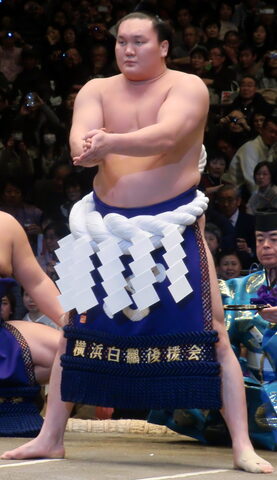
Photo: FourTildes / CC BY-SA 3.0
Hakuho (白鵬 翔, born Mönkhbatyn Davaajargal on March 11, 1985, in Ulaanbaatar, Mongolia) is the 69th Yokozuna in professional sumo and the greatest sumo wrestler who has ever lived. By every measurable standard — championships won, total victories, consecutive wins, perfect tournaments — Hakuho occupies a tier entirely his own in the 1,500-year history of the sport.
He won 45 tournament championships (yusho), surpassing the previous all-time record of 32 held by the legendary Taiho by an almost incomprehensible margin. He accumulated 1,093 wins in the top Makuuchi division — also an all-time record. His 63-bout consecutive winning streak in 2010 set the modern record and remains second all-time, behind only the legendary Futabayama's 69 consecutive wins set in the pre-war era. He completed 16 perfect 15-0 tournaments, winning every single bout in a six-week tournament on sixteen separate occasions.
See exactly how Hakuho's 45 titles compare with every other legend in our ranking of the most sumo championships in history.
Hakuho competed professionally from March 2001 to September 2021 — a 20-year career in which he dominated sumo to an extent unprecedented in the sport's modern era. He was promoted to Yokozuna in July 2007, becoming the 69th wrestler to hold the sport's highest rank, and he held that rank for 14 years until his retirement. After retirement he became stable master of Miyagino Stable (宮城野部屋). The stable was subsequently dissolved in 2024 following a disciplinary incident, with its wrestlers redistributed to other stables.
🌏 Early Life & Path to Sumo
Olympic blood: his father's legacy
Hakuho was born into a family with deep athletic roots. His father, Jigjidiin Mönkhbat (ジグジディン・モンクバト), was a celebrated Mongolian freestyle wrestler who won the silver medal at the 1968 Mexico City Olympics in the 87kg freestyle wrestling category. Growing up in Ulaanbaatar, the young Davaajargal absorbed a family culture of competitive sport, physical discipline, and the relentless pursuit of excellence.
Mongolia has a long tradition of the "Three Games of Men" — wrestling (бөх), archery, and horse racing — and Hakuho's father was one of the country's most celebrated athletes. The Olympic silver medal was a source of immense national pride, and for the young Hakuho, it represented both an inheritance and a challenge to surpass.
The journey to Japan
At just 15 years old, Hakuho traveled from Mongolia to Japan to pursue a career in professional sumo. This was not an unusual path — Mongolian wrestlers had begun finding success in Japanese sumo in the late 1990s and early 2000s, with his compatriot Asashoryu paving the way. Hakuho joined Miyagino Stable (宮城野部屋) in Tokyo, far from his family and homeland, communicating in a language he had only begun learning.
The adjustment was demanding. Sumo stable life is rigorous, hierarchical, and physically punishing — especially for a teenager competing against experienced professionals. But Hakuho's natural ability and ferocious work ethic were immediately apparent to those around him. Within a few years, it was clear that something extraordinary was unfolding.
📈 Professional Career Rise
Debut and rapid ascent (2001–2004)
Hakuho made his professional debut in the March 2001 basho, entering the sport's lowest ranks. His ascent through the lower divisions was swift. He reached the top Makuuchi division in the January 2004 basho — approximately three years after his debut — displaying the technical purity and competitive drive that would come to define his career.
First championship and Sanyaku rise (2006)
In May 2006, competing as an Ozeki, Hakuho won his first tournament championship with a 14-1 record. This performance announced him as a future Yokozuna candidate. Having already risen through the Sanyaku ranks (Komusubi, Sekiwake) and reached Ozeki, he continued racking up dominant results through the remainder of 2006.
Yokozuna promotion (2007)
In June 2007, the Japan Sumo Association's Yokozuna Deliberation Council recommended Hakuho for promotion to Yokozuna after his performance across the prior tournaments. He was formally promoted as the 69th Yokozuna, becoming the second Mongolian wrestler to hold the rank (after Asashoryu). His promotion came in his 25th professional tournament — rapid, though not yet the historically unprecedented speed that Onosato would later achieve. At 22 years old, Hakuho was one of the youngest active Yokozuna in decades.
Establishing undisputed supremacy (2008–2012)
From 2007 onward, Hakuho entered a phase of dominance that sumo had not seen in generations. With the retirement of Asashoryu in 2010 following a controversy, Hakuho stood as the undisputed face of the sport — and he rose to the moment completely. He won tournament after tournament, posting not just victories but perfect 15-0 records with extraordinary regularity. In 2010 alone he won six of the year's six tournaments and set a modern record of 63 consecutive wins, the second longest in history.
Breaking the all-time record (2015)
In September 2015, Hakuho won his 33rd tournament championship, surpassing the all-time record of 32 held by the legendary Taiho (大鵬) — widely considered the greatest yokozuna of the previous era. The moment was deeply emotional for the sumo world. Taiho's record had stood for decades as a benchmark many thought would never be challenged, let alone surpassed. Hakuho broke it and continued to 45.
Later career and retirement (2016–2021)
Hakuho's later career was marked by both continued brilliance and mounting injuries — particularly to his right knee, which required surgery, and to his thumb. He missed numerous tournaments (kyujo) but when he competed, he remained lethal. He was also increasingly controversial for occasionally using tactics considered unbecoming of a Yokozuna — specifically henka (sidestepping at the initial charge) and harite (open-palm slapping) — which drew public criticism even as his dominance continued.
In July 2021, competing despite serious injury, Hakuho won his 45th and final championship with a perfect 15-0 record at the Nagoya Basho — his 16th and final zensho yusho. He retired in September 2021 without competing further — a perfectly scripted final act for the greatest career in sumo history.
🏆 Records — The Greatest of All Time
The sheer scale of Hakuho's records requires context to appreciate. These are not incremental improvements over predecessors — they represent a fundamental redefining of what is possible in professional sumo.
45 tournament championships — all-time record
The previous record was 32, held by Taiho — a figure so revered that he was essentially synonymous with sumo greatness for half a century. Hakuho not only broke that record but exceeded it by 41%. He won his final championship at age 36 with a damaged knee. The 45 yusho span every era of his career: as a young pretender, as an undisputed champion, and as an aging titan battling injury.
1,093 Makuuchi wins — all-time record
Winning 1,093 bouts in the top division represents extraordinary longevity combined with extraordinary dominance. Most top-division wrestlers compete in six tournaments per year, with 15 bouts each — a maximum of 90 bouts annually. Hakuho accumulated his 1,093 wins over 17+ years in Makuuchi, with a loss total of only 162 — a win percentage of approximately 87%.
63 consecutive wins — modern record, 2nd all-time (2010)
Between January and November 2010, Hakuho won 63 consecutive bouts before losing to Harumafuji at the Kyushu Basho. This streak shattered the modern record of 53 consecutive wins held by Chiyonofuji. It is the second longest winning streak in sumo history, behind only the legendary Futabayama (双葉山), who set the all-time record of 69 consecutive wins in 1936–1939 — a pre-war era record that Hakuho came closest to in the modern age.
16 perfect 15-0 tournaments — all-time record
A "zensho yusho" — winning all 15 bouts in a six-week tournament — is one of sumo's rarest achievements. Most great wrestlers achieve one or two in a career. Hakuho achieved 16. The previous record was 8, held by Taiho. In Hakuho's 16 perfect tournaments, he compiled a 240-0 record — not dropping a single bout across the equivalent of more than a full year of tournament action.
86 wins in a single year (2010)
Hakuho's 2010 season produced 86 wins across six tournaments — the most by any wrestler in a single calendar year. He won every tournament that year. This total has never been approached since.
📊 Hakuho vs. Sumo's All-Time Greats
Tournament championships (yusho) — all-time leaders:
Hakuho's 45 titles are 41% more than Taiho's previous all-time record of 32. For comparison: winning 10 yusho is considered a hall-of-fame career for most wrestlers.
🥇 Tournament Championships (Selected Highlights)
Hakuho won 45 championships across his career. Key milestones shown below:
| # | Basho | Record | Rank at time | Significance |
|---|---|---|---|---|
| 1st | May 2006 (Natsu) | 14–1 | Ozeki | First career yusho — announced future greatness |
| 3rd | July 2007 (Nagoya) | 15–0 | Yokozuna | First championship as Yokozuna — perfect record |
| 14th | November 2009 (Kyushu) | 15–0 | Yokozuna | Dominant zensho yusho as supreme champion |
| 15th | January 2010 (Hatsu) | 15–0 | Yokozuna | Start of historic 63-consecutive-win streak (modern record, 2nd all-time) |
| 18th | July 2010 (Nagoya) | 15–0 | Yokozuna | 4th of 6 consecutive titles in 2010 |
| 33rd | September 2015 (Aki) | 14–1 | Yokozuna | ★ Breaks Taiho's all-time record of 32 yusho |
| 42nd | March 2019 (Haru) | 15–0 | Yokozuna | Perfect record |
| 45th | July 2021 (Nagoya) | 15–0 | Yokozuna | ★ Final championship — perfect 15-0; retired September 2021 |
Full list of all 45 championships available at the Japan Sumo Association official website.
📅 Career Timeline
⚔️ Fighting Style
Belt wrestling mastery (yotsu-zumo)
Hakuho was primarily a yotsu-zumo (belt wrestling) specialist. His preferred grip was right-hand inside (右四つ) — right arm under the opponent's left arm, reaching the mawashi. Once he established this grip, the combination of his height, reach, strength, and technical precision made him nearly impossible to defeat. His most frequent winning technique was yorikiri (force-out) — a controlled, efficient drive to the edge.
His second most common winning technique was uwatenage (over-arm throw) — using his long reach to grip over the opponent's arm and generate the rotational force to throw. Hakuho's throws were notable not just for their frequency but for their control: he rarely looked panicked or desperate, executing even dramatic throws with an almost surgical calm.
Technical perfection
What distinguished Hakuho from every contemporary and most historical champions was not raw physical superiority alone — it was the integration of every technical element at the highest possible level simultaneously. His tachiai (initial charge) was explosive and precisely timed. His balance was so refined that opponents who tried to throw him usually found themselves thrown instead. His footwork allowed him to adjust mid-bout, rotating around his center of gravity in ways that confused opponents used to more static wrestlers.
Sumo coaches and analysts repeatedly described Hakuho as having essentially no technical weakness — a belt wrestler who could also push effectively, a right-hand specialist who could adapt when denied his grip, a physical giant who moved with the speed of a much lighter man.
Psychological dominance
Beyond technique, Hakuho was famous for his psychological control of bouts and rivals. His pre-bout ritual — including an extended stare at his opponent — was designed to impose mental pressure before the first charge. Many opponents reported feeling beaten before the tachiai. Competitors who faced him at peak form described a quality beyond technique: an aura of inevitability that made resistance feel futile.
Adaptability and controversial tactics
In his later career, Hakuho increasingly used tactics that drew public and institutional criticism. Henka — sidestepping the opponent's charge at the tachiai — was considered unsporting for a Yokozuna, who is expected to meet opponents directly. Harite (open-palm slapping) at the tachiai was also criticized. The Yokozuna Deliberation Council formally noted its disapproval on multiple occasions.
Hakuho's defenders argued that adapting his tactics as injuries limited his physical output was pragmatic, not dishonorable, and that his career results spoke for themselves. The debate reflects a broader tension in sumo between sporting strategy and the cultural expectations placed on the sport's highest rank.
Versatility with oshi attacks
While Hakuho's reputation rests on belt wrestling, he was also capable of effective oshi-zumo (pushing and thrusting). He used this especially as a secondary threat to keep opponents from simply waiting for his belt. The dual threat — go for the belt, or absorb crushing thrusts — made his offensive game holistically difficult to defend against.
🌟 Legacy & Influence
Redefining the standard of greatness
Hakuho's legacy in sumo is unusual in that it is simultaneously uncontested and almost impossible to fully absorb. Every other wrestler in sumo history — past and present — is now measured against him, and every other wrestler falls short. The question for future Yokozuna is not whether they can match Hakuho's records (almost certainly impossible) but whether they can compete at a level that keeps the memory of his dominance vivid.
He transformed the way sumo's all-time records are understood. Before Hakuho, Taiho's 32 yusho was considered essentially unreachable. After Hakuho's 45, the benchmark itself has been so thoroughly reset that no other wrestler's total — past or future — is likely to provoke meaningful comparison.
Impact on Mongolian sumo
Hakuho is the most prominent figure in a broader transformation of professional sumo by Mongolian wrestlers. He, along with Asashoryu, Harumafuji, Kakuryu, and Terunofuji, represents a generation in which Mongolian-born wrestlers dominated the Yokozuna rank for two decades. His success inspired generations of Mongolian youth to pursue sumo, and his role as stable master continues this influence by training future competitors — some of whom may themselves be of Mongolian heritage.
International popularization of sumo
Hakuho's dominance coincided with and contributed to sumo's growing international profile. International broadcast deals, NHK World coverage, and digital media brought sumo to audiences worldwide during his peak years. For many international fans who discovered the sport after 2007, Hakuho is their first and defining image of what sumo looks like at its best — a complete athlete operating at absolute mastery.
Cultural figure in Japan
Despite being Mongolian-born, Hakuho became deeply embedded in Japanese culture during his 20-year career. He learned Japanese fluently, participated in cultural traditions, obtained citizenship, and was treated by the Japanese public as one of their own sporting legends. His retirement generated the same level of national reflection as a landmark athlete in any country retiring — a recognition that something rare and irreplaceable had come to an end.
🏟️ Life After Retirement — Stable Master
Life as Stable Master — Miyagino Stable
Following his retirement in September 2021, Hakuho undertook the qualification process required to become a sumo stable master (親方, oyakata). This required passing examinations and securing his elder name. His Japanese citizenship, obtained in 2019, was essential — the role is restricted to Japanese nationals. In 2022, he inherited and ran Miyagino Stable (宮城野部屋). The stable was subsequently dissolved in 2024 following a serious internal disciplinary incident involving one of its wrestlers, and the remaining members were absorbed into other stables.
As a stable master, Hakuho brings an unprecedented wealth of firsthand knowledge. He has experienced everything professional sumo demands — the physical preparation, the technical refinement, the psychological management, the management of long-term injury, and the highest levels of competitive pressure. No coach in sumo history has been able to draw on this depth of personal achievement.
Coaching philosophy
Hakuho has spoken about wanting to transmit not just technique but the competitive mindset that drove his own dominance — the idea that preparation, attention to detail, and psychological resilience are as important as physical gifts. He is particularly focused on the early stages of wrestler development, where habits and technical foundations are established that persist throughout a career.
Sumo's Olympic ambitions
Hakuho has been publicly involved in discussions about sumo's potential inclusion in or association with the Olympic Games. He sees international recognition of sumo as an important goal for the sport's future, reflecting both his experience as someone who bridged Mongolian and Japanese athletic cultures and his desire to see sumo grow globally.
📺 Watch Hakuho — Archival Footage & Resources
Where to watch Hakuho's greatest bouts
While Hakuho has retired, his career is extensively documented. The Japan Sumo Association's official YouTube channel (sumo_npo) hosts highlight footage from his career. NHK World has produced multiple documentaries covering his records and milestones, freely available on their platform. Sumo Reference (sumodb.sumogames.de) provides complete bout-by-bout records for every tournament of his career.
Watch on NHK World (free)