📺 How to watch Onosato live
Outside Japan, sumo is broadcast via NHK World (free, highlights) and ABEMA (live full coverage, subscription required). During the 6 annual tournaments, every bout is streamed live. The Japan Sumo Association also posts highlight clips on their official YouTube channel.
How to watch sumo online →👤 Who is Onosato Daiki?
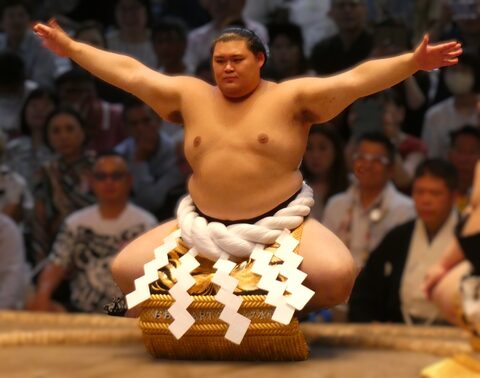
Photo: TSUBAME98 / CC BY-SA 4.0
Onosato Daiki (大の里 泰輝) — born Nakamura Taiki on June 7, 2000, in Tsubata, Ishikawa Prefecture — is the 75th Yokozuna in the history of professional sumo and the sport's most dominant active force. He rose to sumo's highest rank in May 2025 after just 13 professional tournaments, the fastest promotion in modern history by a significant margin.
His achievement carries profound cultural weight in Japan: Onosato is the first Japanese-born Yokozuna since Kisenosato in 2017, ending an eight-year period in which all grand champions came from Mongolia. In a sport deeply tied to Japanese national identity, his emergence has been met with the kind of public excitement not seen since Kisenosato's own promotion.
At 192cm and approximately 188kg, Onosato combines the physical attributes of sumo's elite heavyweights with a speed and technical precision that is genuinely unusual for his size class. He trains at Nishonoseki Stable under the guidance of his stable master — former Yokozuna Kisenosato, himself the last Japanese-born grand champion before Onosato — creating a rare continuity of Japanese yokozuna mentorship.
🎓 Amateur Career — 13 Titles, a Record
Onosato began wrestling at age 7 at the Tsubata Junior Sumo Club (津幡町少年相撲教室) in Ishikawa Prefecture. He developed steadily through his youth, but his truly exceptional talent revealed itself at Nippon Sport Science University (日本体育大学, "Nittai"), one of Japan's premier sumo programs.
During his four undergraduate years, Onosato won an extraordinary 13 amateur titles — tying the all-time record for the most amateur championships ever accumulated by a future professional wrestler. He was named Amateur Yokozuna (全日本学生横綱) in consecutive years, a distinction that marks the very peak of university sumo. Sumo analysts called him "the most eagerly awaited prospect to come out of collegiate sumo in decades."
His amateur record set expectations almost impossibly high — and he has exceeded them.
Amateur highlights
- Started wrestling age 7 — Tsubata Junior Sumo Club, Ishikawa
- Nippon Sport Science University (日体大)
- 13 amateur championship titles — tied all-time record
- 2× consecutive Amateur Yokozuna (全日本学生横綱)
- University Championship (全日本学生相撲選手権) × 1st year win
- Kokutai Tournament winner × 1st year
- Debuted professional as Makushita 10 tsukedashi (special entry) due to amateur achievements
🚀 Professional Career — The Fastest Rise in History
Onosato turned professional at the July 2023 Nagoya Basho, entering via the makushita tsukedashi system at Makushita 10 — a special privilege granted to wrestlers with exceptional amateur records. From his very first tournament, the trajectory was extraordinary.
He reached the top Makuuchi division in January 2024, his 4th professional tournament. By May 2024 — his 7th tournament — he had won his first top-division championship, the fastest debut-to-first-title in modern records. He was promoted to Ozeki after just 9 tournaments, the fastest in the post-war era.
The Yokozuna promotion came in May 2025. After winning back-to-back championships at Ozeki, the Yokozuna Deliberation Council unanimously recommended his elevation to the 75th Yokozuna. He had appeared in just 13 professional tournaments — shattering the previous modern record by 8 tournaments. He is also, uniquely, the only wrestler in modern history to reach Yokozuna without a single losing record in any tournament along the way.
In 2025, he won 3 yusho and accumulated 71 wins for the year — the best annual total by a Japanese wrestler since Yokozuna Takanohana in 1997. He claimed the Hochi Annual Best Wrestler Award (報知年間最優秀力士賞) for the year.
🏆 Tournament Championships (Yusho)
📅 Career Timeline
📊 How Fast? Comparing to Sumo's Greatest
Tournaments needed to reach Yokozuna from professional debut:
Note: Hakuho is the greatest yokozuna of all time with 45 championships. The comparison above is purely about promotion speed.
⚔️ Fighting Style
Belt wrestling first (yotsu-zumo)
Onosato's primary approach is yotsu-zumo — belt wrestling. He seeks a right-hand inside grip (右四つ) on his opponent's mawashi early in the bout, then drives forward with overwhelming force. His most common winning technique is yorikiri (force-out), which accounts for a significant proportion of his victories. Once he establishes his preferred grip, very few wrestlers can resist the combination of his weight, leg drive, and balance.
Oshi threat keeps opponents honest
What prevents opponents from simply blocking his belt attempts is his credible oshi-zumo game — powerful thrusting and pushing attacks that he deploys when the belt is not immediately available. This dual threat makes his offensive approach exceptionally difficult to defend: if you brace for thrusts, he goes to the belt; if you give him the belt, he drives you out.
Size with unusual athleticism
At 192cm and approximately 188kg, Onosato is among the larger wrestlers in the top division. What sets him apart from others in this weight class is footwork and recovery speed that would be considered exceptional for a wrestler 30kg lighter. Analysts have compared his blend of power and technical sophistication to former Yokozuna Takanohana (technical mastery) and Musashimaru (raw physical dominance) — a combination that, if accurate, describes something genuinely rare in sumo history.
🏯 Nishonoseki Stable & Mentor Kisenosato
Onosato trains at Nishonoseki Stable (二所ノ関部屋), one of professional sumo's most historically prominent stables. His stable master is the former Yokozuna Kisenosato (稀勢の里, the 72nd Yokozuna), who retired in 2019 after a career defined by both triumph and persistent injury.
The mentor-student relationship carries significant symbolic weight. Kisenosato was himself the last Japanese-born Yokozuna before Onosato — a wrestler who became a national hero by ending a long drought of Japanese grand champions, only to retire early due to injury. Training the next Japanese Yokozuna represents, for Kisenosato, a form of completion.
Onosato has spoken about choosing Nishonoseki specifically because of its relative isolation from urban distractions — a deliberate choice to prioritize training environment over convenience. This level of dedication from a wrestler his age is noted by observers as one of the keys to his unusually fast development.