- The Short Version: Why Everyone Is Watching
- Profile & Basic Stats
- From Vinnytsia to the Dohyo: Fleeing War
- Career Timeline & Record
- The Records He's Already Broken
- Fighting Style: Why He Wins at 142 kg
- Personal Life & Personality
- Awards & Prizes
- Three Titles: How They Happened
- Yokozuna Watch
- Two Ukrainians: Aonishiki & Shishi
- International Attention
- Watch Aonishiki
- In His Own Words — translated from Japanese sources
- FAQ
🌟 The Short Version: Why Everyone Is Watching
In November 2025, a 21-year-old Ukrainian wrestler walked out onto the dohyo at the Fukuoka Kokusai Center, faced Yokozuna Hoshoryu in a championship playoff, and won. Aonishiki Arata had just become the first Ukrainian in the 1,500-year history of sumo to claim a Grand Tournament title.
Two months later, he did it again.
His first Yokozuna bid in March 2026 ended in his first-ever losing record, and after sitting out the May 2026 tournament he dropped to sekiwake — only to win a third title in July 2026 and regain ōzeki at once. He went 11–4 as Ōzeki 2 East in September 2026, and on the November 2026 Kyushu Basho banzuke he is Ōzeki 1 East — the top-ranked ōzeki. What makes his story extraordinary isn't just the wins. It's the path that led here: a Ukrainian kid who started practising sumo in Eastern Europe, survived a war, crossed an ocean, and climbed from debut to the top of the sport in under three years.
(fastest in modern history)
Nov 2025 · Jan 2026 · Jul 2026
as of November 2026
in sumo history
🏷️ Aonishiki Arata — Profile & Basic Stats
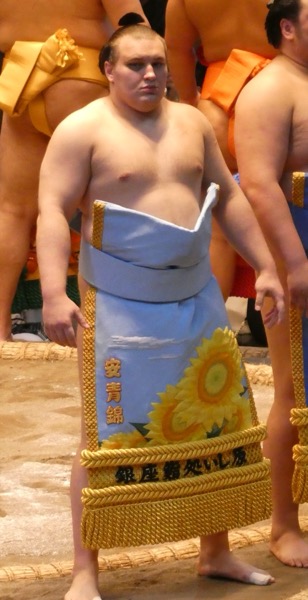
Photo: TSUBAME98 / CC BY-SA 4.0
| Detail | Info |
|---|---|
| Ring name (shikona) | 安青錦 新大 (Aonishiki Arata) |
| Real name | Danylo Yavhushyn (ダニーロ・ヤブグシシン) |
| Born | March 23, 2004 · Vinnytsia, Ukraine |
| Nationality | 🇺🇦 Ukrainian |
| Nickname | Danya (ダーニャ) |
| Height / Weight | 182 cm / 142 kg |
| Blood type | B |
| Stable | Ajigawa (安治川部屋) |
| Current rank | Ōzeki 1 East (November 2026 Kyushu Basho banzuke) |
| Career record | 158–49 with 15 absences, through September 2026 (sumo-api.com) |
| Professional debut | September 2023 (Aki Basho) |
| Top division debut | March 2025 (Haru Basho) |
| Yusho (championships) | 3 (Kyushu 2025, Hatsu 2026, Nagoya 2026) |
| Primary technique | Yorikiri (frontal force-out), oshidashi |
| Grip preference | Migi-yotsu (left outside, right inside) |
What Does "Aonishiki" Mean?
The ring name 安青錦 (Aonishiki) was constructed with deep meaning by his stable master Ajigawa. The characters 安 and 錦 are taken from the master's own wrestling name, Aminishiki (安美錦). The middle character, 青 (ao, meaning "blue"), is a double reference: the blue of the Ukrainian national flag, and his own striking blue eyes — rare in the sumo world. The given name 新大 (Arata) honours Yamanaka Arata, the Kansai University sumo captain who helped guide him when he first arrived in Japan.
🇺🇦 From Vinnytsia to the Dohyo: Fleeing War
April 2022: A Decision That Changed Everything
Aonishiki — then still Danylo Yavhushyn — began his combat sports journey early: he started judo at age six and encountered sumo at age seven in Vinnytsia, a city in central Ukraine. He also trained in wrestling alongside sumo. By 2019 he had already placed third in the World Junior Sumo Championships. Sumo wasn't a hobby; it was his chosen path. He had first visited Japan at age 15, travelling for competitions and training before the war changed everything.
Then on February 24, 2022, Russia launched its full-scale invasion of Ukraine. Danylo was 17 at the time — his 18th birthday, on March 23, 2022, was weeks away. Vinnytsia, a civilian city, would later be struck by missile attacks. According to interviews, he first evacuated to Germany to stay with his parents, before making the decision to continue to Japan to pursue sumo professionally.
In April 2022, Danylo arrived in Japan. He began training at Kansai University's sumo club — one of Japan's elite university programmes — under the guidance of people who would become the foundation of his Japanese life. He lived with the family of Yamanaka Arata, the university sumo captain who helped him settle in. Eighteen months later, he entered professional sumo.
"I Looked Into His Eyes and Said: Come to My Stable"
The story of how Aonishiki ended up at Ajigawa Stable is itself extraordinary. Ajigawa oyakata (the former Aminishiki) had a firm policy: no foreign wrestlers. His stable was newly established, and he believed he needed to build a foundation with Japanese wrestlers first. He had turned away multiple foreign applicants.
Then in August 2022, Ajigawa received a call from Kōji Fukuda, a former sumo coach at Hōtoku Gakuen High School in Hyōgo, asking him to meet a Ukrainian teenager. Ajigawa travelled there intending to politely decline. But the moment he met Danylo, something changed.
It was a decision that would change both their lives. The sumo world had seen foreign-born wrestlers before — Mongolians, Americans, Georgians, Bulgarians. But a Ukrainian refugee making the jump to professional sumo was something rare — only Shishi had come from Ukraine before him. From his first appearance in the lower divisions, it was clear this wasn't a novelty story. The technique was already there.
The Hodo Station Interview: "I Want to Do Sumo at the Kokugikan"
In July 2025, during the Nagoya Basho, Japan's major news programme Hodo Station (報道ステーション) broadcast an exclusive feature on Aonishiki. At the time he was ranked Maegashira — already impressive, but not yet at the level that would come. In the interview, he spoke about his family still affected by the war, his gratitude to the people who supported him, and his dream.
Four months later, he won the championship at Fukuoka. Two months after that, he won again — this time at the Kokugikan itself, the very place he had dreamed of conquering.
Shuzo Matsuoka in London: The Message He Wanted to Share
In October 2025, sumo held an overseas exhibition in London — the first in 34 years. Around that trip, sports journalist and former tennis star Shuzo Matsuoka conducted an exclusive interview with Aonishiki for Hodo Station, exploring what the Ukrainian wrestler wanted to convey through sumo on the international stage. The segment, which aired on November 4, 2025, captured a young man carrying the weight of his country's story into a sport that has been Japanese for centuries.
📈 Career Timeline
Born in Vinnytsia, Ukraine
Danylo Yavhushyn is born on March 23 in Vinnytsia, a city of roughly 370,000 in west-central Ukraine.
Starts judo, age 6
Begins judo training as his first combat sport — a foundation that would later inform his grappling technique in sumo.
Encounters sumo, age 7
Begins competitive sumo in Ukraine, part of the country's small but dedicated sumo community. Also trains in wrestling alongside sumo.
First visit to Japan, age 15
Travels to Japan for competitions and training — his first exposure to the country that would become his home.
World Junior Championships: 3rd place
Places third at the World Junior Sumo Championships — early evidence of international-level ability.
Russia invades Ukraine
Full-scale Russian invasion begins. Danylo is 17. Vinnytsia will later be struck by missiles. He first evacuates to Germany to stay with his parents.
Arrives in Japan
Travels from Germany to Japan to pursue sumo professionally. Joins Kansai University sumo club, a top-level amateur programme. Lives with the family of captain Yamanaka Arata, whose name he will later take. Attends language school to learn Japanese.
Professional debut (Aki Basho) — Jonokuchi champion
Enters professional sumo under the ring name Aonishiki Arata, competing for Ajigawa Stable. Goes 7-0 in Jonokuchi and wins the division championship (Nov 2023). Begins a remarkable 20-bout winning streak from debut.
Jonidan champion
Wins the Jonidan division championship, continuing his unbeaten run. The 20-bout winning streak eventually ends in Sandanme (March 2024).
Reaches juryo in 7 tournaments
Promoted to the juryo division (the second division, first of the salaried ranks) just 7 tournaments after his debut — the fifth-fastest since the six-tournament year began in 1958. Upon promotion, Kansai University's sumo club presented him with a ceremonial belt (化粧まわし).
Top division in 9 tournaments
Makes his makuuchi debut just 9 tournaments after his debut — tied for the fastest on record — and wins the Fighting Spirit Prize with 11–4.
Promoted to Komusubi — defeats undefeated Yokozuna
Reaches san'yaku in just 12 tournaments — the fastest since 1958 for a wrestler who started from the bottom of the banzuke (excluding tsukedashi entrants). On Day 12 of the Aki Basho, he defeated Yokozuna Hoshoryu — who was 11-0 at the time — via kirikaeshi (twisting knee trip). A Komusubi toppling an undefeated Yokozuna is an exceptional result that announced Aonishiki as a legitimate top-tier contender.
🏆 First Ukrainian Yusho — Kyushu Basho
In his first tournament as a sekiwake — reached in a record 13 tournaments, beating Konishiki's 14 — he finishes 12-3, then defeats Yokozuna Hoshoryu in the championship playoff. Becomes the first Ukrainian in sumo history to win a Grand Tournament title. Days later, promoted to Ozeki.
Promoted to Ōzeki — 14 tournaments from debut
The Japan Sumo Association board unanimously approves Ozeki promotion. The 14-tournament path surpasses Kotooshu's 19 for the fastest modern promotion from debut. At 21 years 8 months, his promotion is the fourth-youngest on record.
🏆 Back-to-back: Hatsu Basho Yusho
Wins the New Year tournament 12-3 after a playoff against Atamifuji — the first new Ozeki to win his debut tournament at the rank since Hakuho in May 2006. Two consecutive titles place him squarely in the Yokozuna promotion conversation.
Yokozuna bid ends in first losing record
Competing in Osaka for promotion, he hurts his left foot during the tournament and finishes 7-8 — the first losing record of his career, ending a run of 14 straight winning records since his debut. (In April the JSA published a diagnosis of a fractured left little toe.)
Sits out the Natsu Basho
As a kadoban ōzeki, he withdraws from the entire tournament (0-0-15) and drops to sekiwake for July.
🏆 Third title — and straight back to Ōzeki
As a sekiwake at the Nagoya Basho he finishes 12-3, then wins a three-way playoff against Atamifuji and Kirishima. The double-digit total regains his ōzeki rank immediately, and he adds a fourth Technique Prize.
Ōzeki again — 11-4
Back at Ōzeki (2 East) for the Aki Basho, he finishes 11-4.
🏅 The Records He's Already Broken
Aonishiki's rise isn't just fast — it is historically anomalous. To understand how unusual his trajectory is, it helps to compare against previous record-holders:
| Milestone | Aonishiki | Previous Record | Holder |
|---|---|---|---|
| Debut → Komusubi | 12 tournaments | — | Fastest since 1958 (excl. tsukedashi) |
| Debut → Sekiwake | 13 tournaments | 14 tournaments | Konishiki |
| Debut → Ōzeki | 14 tournaments | 19 tournaments | Kotoōshū |
| Debut → Makuuchi | 9 tournaments | 9 tournaments (tied) | Jokoryu, Takerufuji |
| Winning streak from debut | 20 bouts | — | Ended in Sandanme (Mar 2024) |
| First Ukrainian Yusho | Nov 2025 | Never before | Historic first |
| Win debut Ozeki tournament | Jan 2026 | May 2006 | Hakuho |
| Consecutive winning records from debut | 14 tournaments | — | Reached Ōzeki without a losing record; streak ended Mar 2026 (7-8) |
The consecutive-winning-record stat is particularly remarkable. From his debut until March 2026, Aonishiki never finished a tournament with more losses than wins — he climbed all the way to ōzeki without a single losing record, something Japanese media described as only the second such case since the Showa era. The run of 14 straight winning records ended with his 7-8 in March 2026.
🥊 Fighting Style: Why He Wins at 142 kg
At 182 cm and 142 kg, Aonishiki is undersized for the top division. On the September 2026 banzuke the average top-division wrestler stood about 184 cm and weighed about 158 kg (sumo-api data) — roughly 2 cm taller and 16 kg heavier than him. In a sport where mass and leverage are fundamental, that's a meaningful disadvantage. So how is he winning?
Migi-Yotsu: The Foundation
Aonishiki's preferred grip is migi-yotsu — left hand on the outside of the opponent's belt, right hand on the inside. Once he secures this grip, he is exceptionally difficult to dislodge. His lower centre of gravity and long arms let him dig under larger opponents, taking away their ability to use their weight advantage effectively.
Primary Winning Techniques
His two most common kimarite (winning techniques) are yorikiri (frontal force-out) and oshidashi (frontal push-out) — accounting for the majority of his wins. But what separates him from a straightforward belt wrestler is his versatility. He has recorded six wins by kirikaeshi (a twisting backwards knee trip) — a rare and technically demanding technique that most wrestlers can't execute reliably.
When an opponent pushes him away and breaks his grip, he can seamlessly transition to a thrusting exchange (tsuppari) — as seen in his Aki 2025 win over Takayasu that circulated widely. The ability to win by multiple methods makes him extremely difficult to prepare a single defensive gameplan against.
Technique Breakdown
- Yorikiri (frontal force-out) — primary technique
- Oshidashi (frontal push-out) — near-equal to yorikiri in win share
- Kirikaeshi (twisting knee trip) — 6 career wins; technically rare
- Tsuppari exchanges — fallback when mawashi is unavailable; very effective
- Overall style: technical belt wrestler with versatile fallbacks
🎌 Personal Life & Personality
Known by the nickname "Danya" (ダーニャ) among fans and fellow wrestlers, Aonishiki has become one of the most personable figures in the sumo world. Despite arriving in Japan at 18 with limited Japanese ability, he now speaks the language fluently and regularly appears on major Japanese television programmes conducting interviews entirely in Japanese — a notable achievement in just a few years.
His appearance in the ring is distinctive. His hair remains its natural brown (tea-coloured) — unlike some foreign-born wrestlers who dye their hair black — and his chonmage (topknot) leans noticeably to the left. According to Aonishiki himself, the leftward lean follows a tradition associated with Hawaiian wrestlers, though he has said it has "no particular meaning" beyond that.
When he first arrived in Japan, Aonishiki lived with the family of Yamanaka Arata, the Kansai University sumo captain who helped him settle into Japanese life while he attended language school. That connection is honoured in his ring name: the 新大 (Arata) portion was given in tribute to Yamanaka. Upon his promotion to juryo, the Kansai University sumo club presented him with a ceremonial belt (化粧まわし) — a gesture that visibly moved him.
Off the dohyo, Aonishiki shows a playful side. During a London overseas tour, he was filmed exploring the city with Fujinokawa — together reportedly the youngest pair in the top division — eating fish and chips and joking, "もう10キロ欲しい" ("I want 10 more kilos"). He is also known for his appreciation of the chanko (hot pot) at Ajigawa Stable, which he and others have described as "restaurant quality" (料亭並み).
🏅 Awards & Prizes
| Award | Count | Details |
|---|---|---|
| Grand Tournament Championship (幕内優勝) | 3 | Kyushu 2025, Hatsu 2026, Nagoya 2026 |
| Fighting Spirit Award (敢闘賞) | 2 | Special prize for outstanding fighting spirit |
| Technique Prize (技能賞) | 4 | Jul 2025, Sep 2025, Nov 2025, Jul 2026 |
| Outstanding Performance Award (殊勲賞) | 1 | Nov 2025 |
| Jonokuchi Championship | 1 | November 2023 (7-0) |
| Jonidan Championship | 1 | January 2024 |
The combination of both the Fighting Spirit Award and the Technique Prize is significant — most wrestlers are known for one or the other, but Aonishiki has been recognised for both his raw determination and his technical skill. Winning six special prizes before his 22nd birthday (seven by July 2026) places him among the most decorated young wrestlers in recent memory.
🏆 Three Titles: How They Happened
Kyushu Basho 2025: The Historic First
Going into November 2025 at the Fukuoka Kokusai Center, Aonishiki was ranked Sekiwake and widely considered a potential yusho contender — but few predicted he would actually take it. He finished the 15 days at 12-3, a strong record but not dominant. On the final playoff, he faced Yokozuna Hoshoryu — the nephew of Asashoryu, a formidable Yokozuna in his own right.
Aonishiki won. The moment was immediately recognised as historic: the first Ukrainian to ever claim a Grand Sumo Tournament title. Days later, the Japan Sumo Association board voted unanimously to promote him to Ozeki.
Hatsu Basho 2026: Debut Ozeki, Immediate Confirmation
Some newly promoted Ozeki struggle in their first tournament at the new rank — the step up in competition and the psychological weight of expectation take their toll. Aonishiki did the opposite: he won the January 2026 Hatsu Basho at 12-3, beating Atamifuji in a playoff — the first new Ozeki to win his debut tournament at the rank since Hakuho in May 2006.
Two consecutive yusho, the second as Ozeki. The Yokozuna promotion conversation could no longer be avoided.
Nagoya Basho 2026: The Comeback Title
Six months later he was back at sekiwake, after a 7-8 in March and a full withdrawal in May. At the July 2026 Nagoya Basho he finished 12-3 and then beat Atamifuji and Kirishima in a three-way playoff for his third Emperor's Cup — a result that also returned him to ōzeki straight away.
👑 Yokozuna Watch: Can He Make History Again?
The traditional standard for Yokozuna promotion is two consecutive championships, or an equivalent level of performance across multiple tournaments. After his back-to-back titles, Aonishiki went for promotion at the March 2026 Haru Basho in Osaka — but finished 7-8, his first losing record, and then missed the whole May 2026 tournament, costing him the ōzeki rank for one basho.
He answered by winning the July 2026 title as a sekiwake and returning to ōzeki, then went 11-4 in September 2026. A new promotion run would need back-to-back titles or an equivalent record again — but at 22, with three Emperor's Cups already, he remains one of the most likely future Yokozuna.
If promoted, Aonishiki would become the 76th Yokozuna in sumo history — and the first Ukrainian, the first European-born, and one of the youngest ever to reach the sport's pinnacle. The current 75th Yokozuna is Onosato (大の里), promoted in May 2025.
Following every Aonishiki bout live from outside Japan? You need a VPN to access Abema — which streams all sumo free.
🔒 Get NordVPN — Watch Every Bout Live30-day money-back guarantee · ※ affiliate link · Full guide here
🇺🇦🇺🇦 Two Ukrainians: Aonishiki & Shishi
Aonishiki is not the only Ukrainian in professional sumo. A wrestler known as Shishi (獅司) also competes in the professional ranks, making Japan's grand sumo circuit a rare home for two wrestlers from the same war-affected country.
The two Ukrainians first faced each other on Day 12 of the January 2025 Hatsu Basho, in the second-division juryo — and Shishi won. Aonishiki won their next meeting, in the top division in March 2025. Their first bout was widely covered in both the Japanese and international press as a symbol of how far sumo's international reach has extended.
Their parallel journeys — both leaving Ukraine under difficult circumstances, both building careers in an ancient Japanese sport — have attracted significant attention in Ukraine itself, where sumo is now followed more closely than at any point in the country's history.
🌍 International Attention
Aonishiki's story has attracted attention far beyond the sumo world. In July 2025, he appeared on Hodo Station (報道ステーション), one of Japan's most-watched news programmes, for an exclusive interview in which he expressed his desire: "国技館で相撲がしたい" — "I want to do sumo at the Kokugikan" (the spiritual home of sumo in Tokyo).
His journey from war-torn Ukraine to the top of sumo has reportedly been adapted into a film in France, though specific production details remain limited. The story — a teenage refugee who fled an invasion and within three years reached the elite ranks of Japan's national sport — has a narrative quality that has resonated across cultures.
During a London overseas tour, Aonishiki and Fujinokawa (reportedly the youngest pair in the top division at the time) were filmed exploring the city together, bringing a casual, accessible side of sumo to an international audience. The video showed both wrestlers trying fish and chips and navigating London streets — a far cry from the ancient ritual of the dohyo.
Sumo's Growth in Ukraine
Aonishiki's success has significantly raised sumo's profile in Ukraine. The country's small but dedicated sumo community now has a figure competing at the very highest level of the sport. Ukrainian media coverage of sumo has increased substantially since his first tournament victory in November 2025, and his story has become intertwined with broader narratives of Ukrainian resilience during wartime.
📺 Watch Aonishiki — Essential Videos
The best way to understand Aonishiki is to watch him — both on and off the dohyo. These videos capture his personality, fighting technique, and extraordinary journey in ways that statistics alone cannot.
His Story: From Ukraine to Ozeki
This documentary covers Aonishiki's full journey — from his wrestling roots in Ukraine, to fleeing the war, to becoming the first Ukrainian Ozeki in sumo history. The film also touches on how his story has resonated in France, where it has reportedly been adapted into a feature film.
Inside Ajigawa Stable: What Makes Him Strong
A rare look inside Ajigawa Stable, where stable master Ajigawa oyakata (former Aminishiki) discusses what sets Aonishiki apart: his flexibility, his ability to fight under heavier opponents, and his relentless work ethic in training. The video also shows the stable's famously high-quality chanko — described as "restaurant-level" (料亭並み) — which has become a talking point among sumo fans.
Off the Dohyo: London with Fujinokawa
During the overseas tour, Aonishiki and Fujinokawa — the youngest pair in the top division — explored London together. The video captures a lighter side of sumo life: trying authentic fish and chips, walking through the city, and Aonishiki's now-famous quip after eating: "もう10キロ欲しい" ("I want another 10 kilos"). It's a reminder that behind the intense competitor is a 21-year-old with a playful sense of humour.
More Essential Videos
| Video | What You'll See | Why It Matters |
|---|---|---|
| Hodo Station Exclusive | Major Japanese TV news interview (July 2025), when Aonishiki was still Maegashira | His famous quote: "国技館で相撲がしたい" — "I want to do sumo at the Kokugikan." Within months, he had won the championship there. |
| Ozeki Promotion Ceremony | The formal 伝達式 (dendatsushiki) where the JSA officially notifies Aonishiki of his Ozeki promotion | A tradition-heavy moment. Aonishiki delivers his acceptance speech in fluent Japanese — a striking moment for a wrestler who arrived in Japan just four years earlier. |
| New Ozeki Feature (Part 1) | In-depth TV profile covering his rise from Jonokuchi to Ozeki | Includes training footage and behind-the-scenes moments rarely shown for foreign-born wrestlers. |
| Kansai University Belt Presentation | The moment Kansai University's sumo club presents him with a 化粧まわし upon juryo promotion | Shows the deep bond between Aonishiki and the university community that supported him. His quote: "素敵な化粧まわしを着けて九州場所では優勝目指して頑張りたい" (Kansai University, Nov 2024). Note: this was November 2024, when he had just been promoted to jūryō — the “Kyushu” he meant was that tournament, a year before his first top-division title. |
🗣 In His Own Words — from Japanese Sources (Translated)
Most of what Aonishiki says publicly is said in Japanese, at post-bout interviews, promotion ceremonies and press conferences, and never reaches English readers. Below are short excerpts we translated ourselves from the original Japanese reports and videos; longer answers are summarised rather than quoted. Every item links to the specific source, with the date (and the video timestamp where applicable), so you can check the original.
He said he had watched ōzumō videos since long before and they made him think “someday I want to stand on that dohyō myself”; the bout that left the deepest impression was the first he ever saw — Takanohana vs Asashoryu (September 2002). He added that he had always told his parents he would go into professional sumo after university, and they told him: “It’s your life — go the way you decide.”
原文: 「昔から見ています。それを見てから、「オレもいつかは土俵に立ってみたい」と思っていました。/「自分の人生なんで、あなたの決めた道で行きなさい」と言われました。」
My biggest rival is myself. I still can’t attack on my own initiative. I want to get stronger.
原文: 「一番のライバルは自分。自分から攻めるのがまだできていない。もっと強くなりたい」
Ōzumō exists only in Japan — I don’t think anyone walks around Europe in a topknot and kimono — so I want to help people get to know sumo and enjoy it.
原文: 「大相撲って日本にしかないので、ヨーロッパでちょんまげ付けて着物着て歩いている人はいないと思うので、相撲を知ってもらえるように皆さんに喜んでもらえるようにやっていきたい」
It’s a saying about life. Even if you fail, as long as you’re not dead it isn’t over — the experience gets used. In the same piece he said he misses the restaurants of his childhood and simply walking in his home town, but has never once thought of quitting sumo: “What matters is to walk straight along the path I chose.” The hardest thing, he said, was not understanding Japanese.
原文: 「人生に対しての言葉。失敗しても死んでなかったら終わりじゃない。経験が生かされるということ/自分が決めた道をしっかり真っすぐ歩くのが大事と思ってる/日本語が分からなかったことが一番苦労した」
I’m happy, but there is still one more rank above, so that is what I want to aim for.
原文: 「表彰式の優勝力士インタビューで、安青錦は大関昇進が確実になったことについて「うれしいですけど、またもう一つ上の番付があるので、そこを目指していきたい」ときっぱり。」
I had the desire to win, but I didn’t think I actually could. I was really happy. — He also admitted he had “not thought at all” about becoming ōzeki (“that’s something amazing people become”), and that his master had told him to write his own acceptance speech: “If it were just me I could only say ‘I’ll do my best’.”
原文: 「優勝したいという気持ちはあったけど、優勝できるとは思っていなかった。すごくうれしかったです/大関になれると全く考えていない/昨日、親方に『自分で考えろ』と言われたんですけど…」
So as not to disgrace the name of ōzeki, I will devote myself to training, aiming yet higher.
原文: 「大関の名に恥じぬよう、また、さらに上を目指して精進いたします/シンプルな方が自分らしいと思った」
I’m happy, but the feeling that I want to aim one rank higher is stronger. Since entering the sumo world I’ve felt there’s no point doing it unless you aim for the very top. Yokozuna isn’t a place anyone can reach, so I want to do everything I can toward my goal.
原文: 「うれしい気持ちはありますけど、もう1つ上を目指したいという気持ちが強いです。相撲界に入ってから、一番上を目指さないとやる意味がないと思ったので。(横綱は)誰でも上がれる所じゃないし、自分の目標に向けてやれることを全部やっていきたい」
Asked what he struggled with most on the way to ōzeki: “The Japanese. I came with zero.” He has gained about 40 kg since joining, including the trainee period (“about three years”); his famously low posture is “nothing I do consciously — I’ve wrestled low since I was a child”; and on his trademark uchi-muso: “If I did that in the training ring I think I’d get told off — in practice it’s ‘go forward’.” He also said the wrist-flip that beat Ura in London was a wrestling move.
原文: 「日本語はだいぶん苦労しました!…ゼロの状態で来たんで/40kgぐらいです!/子供の時から低い体勢で相撲を取ってたので…自然にそうなってますね/稽古場で内無双やったら怒られると思うんで」
The first title was pure happiness; the second time, along with happiness, I felt relieved. — Asked about being seen singing Kimigayo at the ceremony: “Since I live in Japan I thought I ought to know the national anthem. I looked it up myself and practised a little. It’s not perfect yet.”
原文: 「初優勝の時はうれしい気持ちだったけど、2回目はうれしい気持ちもありながらホッとした/日本で生活している以上(国歌を)知っておいた方がいいなと。自分で調べてちょっと練習した」
While I was out I felt a great deal of frustration and went through many experiences. Through that time I came to love sumo even more. — He gave his own account of the spring: injured mid-tournament in March, his first ever losing record and kadoban; treated for May, then “a different injury in pre-tournament practice” forced the full withdrawal.
原文: 「休場中はたくさん悔しい思いをし、様々な経験をすることができました。その時間を通して、さらに相撲が好きになりました。/場所前の稽古で別のケガをしてしまい、5月場所は全休となりました。」
Not ten wins — I’m aiming for the title. (At a gathering with about 120 Ukrainian evacuees in Tokyo the same day he said that since he became a rikishi more people in Ukraine watch sumo, and he wanted to show them a strong performance in Nagoya.)
原文: 「10勝ではなく、優勝を目指す/力士になってからウクライナでも相撲を見る人が増えた」
I had a strong feeling that I’m not someone who ends here. I’m aiming for the very top rank.
原文: 「ここで終わる人間じゃないという思いが強かった。一番上の番付を目指します」と安青錦。」
I was fighting on the dohyō with fear and anxiety too. It feels like I saw it through. — Rather than counting toward ten wins, “I took it one day at a time, beating the anxiety.” On the playoff: “Every title I’ve won has come through a playoff, so I felt the playoff favoured me.” His master’s words afterwards: “‘Well done’ — and he gave me a hug.”
原文: 「怖さ、不安もありながら土俵で闘っていた。やり切ったという感じ/今まで優勝した時は全て決定戦で勝っている/『よくやったな』と言って、ハグをしていただいた」
All three titles had come via playoffs: “I’d like to clinch it in the regular bouts and taste a different kind of happiness.” (He finished September 11–4.)
原文: 「過去3度の制覇は優勝決定戦までもつれており「本割で決めて、また違ううれしさも味わいたい」と自らを奮い立たせた。」
He’s a very quick-moving rikishi. If I can keep up with Fujinokawa’s movement, the tournament will be no problem. We came up to jūryō together and we’ll be facing each other for the next five, ten years — it’s very good practice, and I’m grateful.
原文: 「すごく動きが速い力士。藤ノ川関の動きについていけば、場所は問題ない。新十両も一緒で、これから5年、10年一緒にやっていく相手。すごくいい稽古になるので、ありがたい」
Details reported in Japanese sources
- JSA official profile (as of the November 2026 banzuke): real name ヤブグシシン・ダニーロ; 182.0 cm / 142.0 kg; favoured style migi-yotsu and yori; career 158–49–15 over 20 tournaments, top division 98–37–15 over 11; debut September 2023, jūryō November 2024, makuuchi March 2025, san’yaku September 2025, ōzeki January 2026. Ring name never changed. (Japan Sumo Association, 2026-11-01)
- JSA rikishi questionnaire: started sumo at 7; favourite food — meat; hobby — sauna; favourite music — Eigo Kawashima; favourite manga — Hajime no Ippo; favourite TV — Junk SPORTS; athlete he supports — boxer Oleksandr Usyk; favourite phrase — 「ありがとうございます」 (“thank you”); the thing he thinks he is No.1 at in the sumo world — “none”. (Japan Sumo Association, 2026-11-01)
- Ring name: 安 from his master Ajigawa (the former sekiwake Aminishiki), 青 from the blue of the Ukrainian flag and of his eyes; the given name 新大 (Arata) from Yamanaka Arata, the Kansai University sumo captain who, per the university’s press release, he had met at an international competition, contacted after fleeing the war, and lived with while training on the club’s dohyō. (Daily Sports; Kansai University press release, 2026-07-27)
- The kesho-mawashi he has worn since March 2026, presented by KPMG Japan, was designed from the traditional embroidery patterns of his home region, Vinnytsia. (KPMG Japan press release, 2026-03-04)
- Official injury record: during the March 2026 tournament he fractured the base of his left little toe (JSA announcement, April 2026) and finished 7–8, his first losing record in 16 tournaments; on 6 May 2026 he sprained his left ankle (lateral ligament injury) in practice and the JSA published a certificate requiring about three weeks’ treatment — he sat out all of May 2026 as a kadoban ōzeki. (Nikkei (Kyodo), 2026-05-10)
Translations are ours and are kept short; quotation marks mark close translations of the wrestler’s words, the rest is paraphrase. Nothing here is taken from English Wikipedia. If a source goes offline, the citation still identifies the publication and date.